


How Hydro Jetting Clears Roots From Sewer Lines
- thetrenchlessguys
- Aug 7
- 6 min read
A slow drain that turns into recurring backups is often more than a clog. In older Akron-area neighborhoods, tree roots can enter sewer joints, cracks, and deteriorated pipe connections, then grow inside the line where moisture and nutrients are constant. Understanding how hydro jetting clears roots helps property owners see why high-pressure cleaning can restore flow quickly, while also recognizing when cleaning alone is not a permanent repair.
Why roots grow into sewer pipes
Roots do not typically crush a sound sewer pipe simply by growing nearby. They find an existing entry point: a separated clay-pipe joint, a failed gasket, a small crack, or a damaged service connection. Once a fine root reaches the pipe interior, it follows the water source. Over time, that thin root mass can expand into a dense blockage that traps toilet paper, grease, wipes, and other debris.
This is especially common with aging clay tile, cast iron, and older concrete sewer lines. It can also happen in newer piping when a joint has shifted, construction has damaged the line, or settling has created a gap. The visible symptom may be a single slow fixture, but a main sewer root intrusion more often causes problems in multiple drains, floor drains, or the lowest plumbing fixtures in the building.
How hydro jetting clears roots from pipe interiors
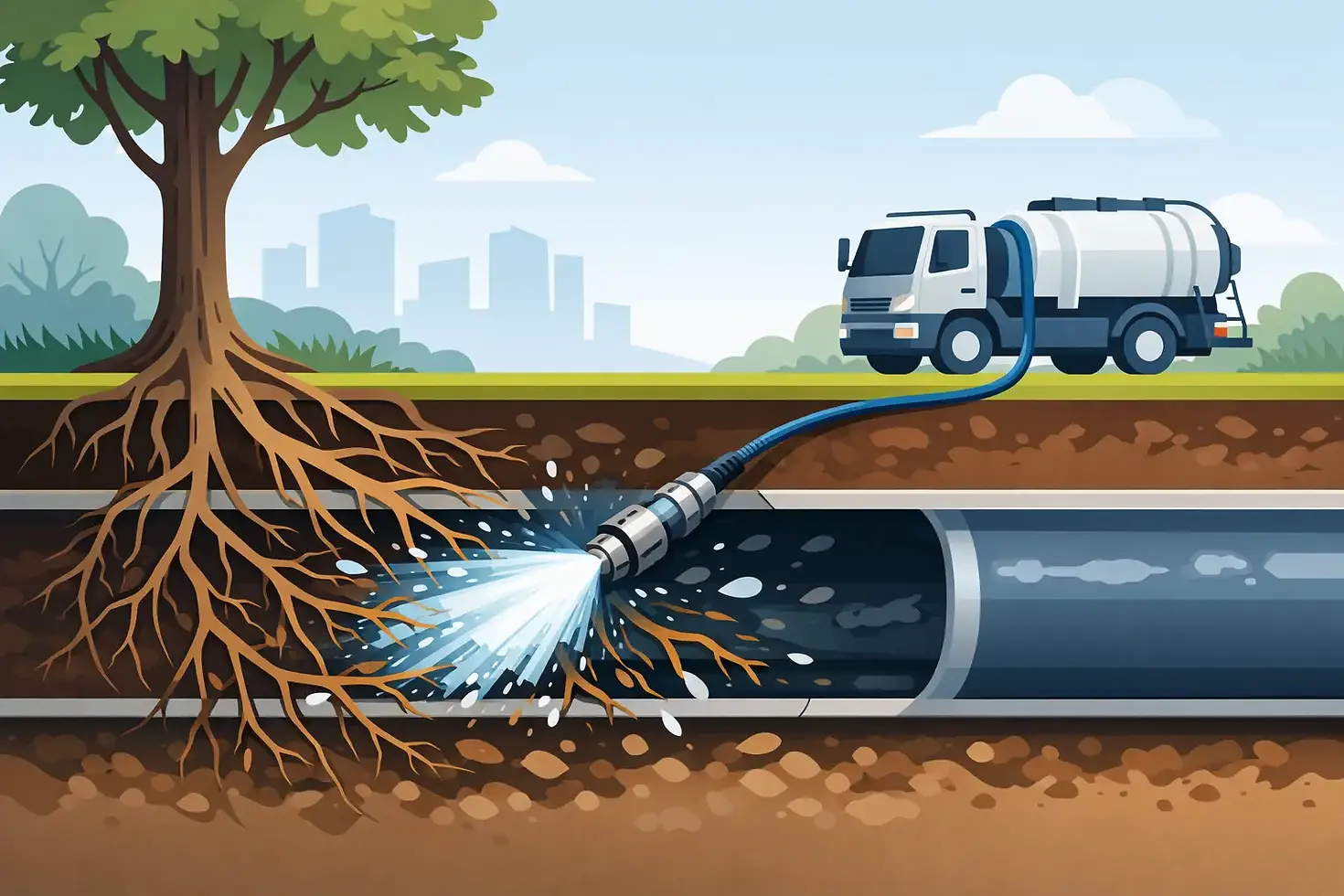
Hydro jetting uses a specialized hose and nozzle connected to a high-pressure water jetting machine. A trained technician inserts the hose through an appropriate cleanout or access point and advances it through the sewer line. The nozzle directs powerful water streams forward and backward. Forward jets break apart the obstruction, while rear-facing jets pull the hose through the line and scour material from the pipe walls.
When the nozzle reaches roots, the pressurized water cuts through fine and moderate root masses, breaks apart accumulated debris, and flushes the loosened material downstream. Unlike a conventional drain cable, which may punch a narrow hole through a blockage, jetting cleans a much wider portion of the pipe interior. That fuller cleaning is valuable because roots often collect grease and debris around them. Removing only the center of the obstruction may restore flow for a short time, but it leaves material behind for the next backup to form.
The exact pressure, nozzle type, hose size, and cleaning approach depend on the pipe material, diameter, line condition, and obstruction. A residential lateral requires a different setup than a larger commercial main. Proper hydro jetting is controlled work, not simply applying maximum pressure to every line.
The nozzle matters
Jetting nozzles are selected for the job at hand. Penetrating nozzles help open a path through heavy debris and root concentrations. Flushing nozzles are designed to move broken material downline. Specialty root-cutting and chain-style tools may be used in appropriate situations, particularly where a dense root mass needs more mechanical action before or after water jetting.
The goal is to restore the pipe's usable diameter without causing unnecessary stress to a compromised line. That is why experienced diagnosis matters as much as the jetting equipment itself.
CCTV inspection comes before and after cleaning
A camera inspection is one of the most useful steps in a root-removal project. Before cleaning, CCTV sewer inspection helps identify where the roots are located, how far they extend, whether the pipe is holding water, and whether the line shows cracks, offset joints, corrosion, or collapse.
That information determines whether hydro jetting is the right first solution. If the camera reveals an intact pipe with roots entering through limited joint gaps, cleaning may be an efficient way to restore service. If it reveals severe fractures, a belly holding debris, missing pipe sections, or a collapse, aggressive cleaning may not solve the underlying issue.
A post-cleaning camera inspection is equally valuable. Once roots and debris are removed, the technician can see the condition that was hidden behind the blockage. Property owners receive a clearer answer: maintain the line, schedule targeted rehabilitation, or plan replacement before a more disruptive failure occurs.
What hydro jetting can fix - and what it cannot
Hydro jetting is highly effective for clearing root intrusions and washing out the buildup that collects around them. It can improve flow, reduce repeat backups, and provide a clean surface for evaluating the pipe. For many homeowners, restaurants, commercial buildings, and multifamily properties, it is a practical minimally invasive service that avoids immediate excavation.
However, water pressure cannot seal the opening that allowed the roots in. If roots entered through separated joints or cracks, they can return over time. The timeline varies widely. A small amount of fine root growth may take years to become troublesome again, while a heavily root-prone line can need maintenance much sooner.
Hydro jetting also cannot correct major structural defects. A crushed, collapsed, severely offset, or extensively deteriorated pipe may require trenchless pipe repair instead. Depending on the condition and layout, options can include cure-in-place pipe lining, pipe coating, or trenchless pipe bursting. These methods address the failed pipe itself while minimizing digging across lawns, driveways, parking areas, and landscaped property.
When jetting is a good first step
Hydro jetting is often the right first move when a camera inspection shows that the pipe remains structurally serviceable and the main problem is root intrusion with debris buildup. It is also useful as preventive maintenance for properties with known root activity, especially when a backup would disrupt tenants, customers, residents, or critical operations.
For a homeowner, that might mean cleaning a root-prone sewer lateral before the next holiday gathering or winter season. For a facility manager, it may mean scheduling maintenance during low-occupancy hours to avoid an emergency closure. The best schedule is not universal. It depends on past backup history, pipe age, tree proximity, use volume, and what the inspection shows.
There are cases where a cable machine may be used first to reopen a completely blocked line, allowing water to drain and giving the jetting hose a workable path. In other cases, jetting is the better primary method because grease, sludge, scale, and roots are all contributing to the restriction. The appropriate method should follow the line condition, not a one-size-fits-all approach.
Why professional equipment and operation matter
High-pressure sewer jetting equipment is powerful enough to cause damage or injury when used incorrectly. Sending a jetting hose into a line without confirming the pipe condition can worsen an existing break, push debris into another restriction, or create a difficult recovery situation. Indoor cleanouts, backed-up lines, and commercial plumbing systems also require careful containment and job planning.
Professional service includes more than running a hose through the drain. It includes selecting the correct access point, verifying the downstream path, controlling pressure and flow, monitoring hose travel, and confirming results with a camera when appropriate. For commercial properties, technicians must also consider building operations, sanitation requirements, and how to keep disruption to a minimum.
The Trenchless Guys Akron approach root problems as both a cleaning issue and an infrastructure question. Clearing the blockage matters immediately. Identifying why it formed is what helps a property owner make a cost-effective decision for the long term.
Signs it is time to investigate root intrusion
Repeated drain clogs are the clearest warning, particularly when multiple fixtures are affected. Gurgling toilets, slow tubs, water at a basement floor drain, sewage odors, or backups after heavy water use can also point to a restricted main sewer line. Mature trees near the sewer route raise the likelihood, but they do not prove roots are the cause. A CCTV inspection provides the evidence needed to avoid guessing.
Do not rely on chemical root killers as a substitute for diagnosis and cleaning. These products may have limited use in specific maintenance situations, but they do not remove heavy debris, correct damaged joints, or show the true condition of the pipe. Some products can also create safety and environmental concerns if used improperly.
Plan for clean flow and a sound pipe
Hydro jetting can give a root-filled sewer line a fresh start by cutting out intrusion and washing away the buildup that causes backups. When inspection shows a pipe worth preserving, planned jetting maintenance may be the most economical path. When the camera shows failure beneath the roots, it provides the information needed to choose a minimally invasive repair before the next blockage becomes an emergency.
If your drains are slowing down again, address the cause while the line is still accessible and the repair options are broader.


Comments